Your Crypto Will Die With You — Unless You Plan for It
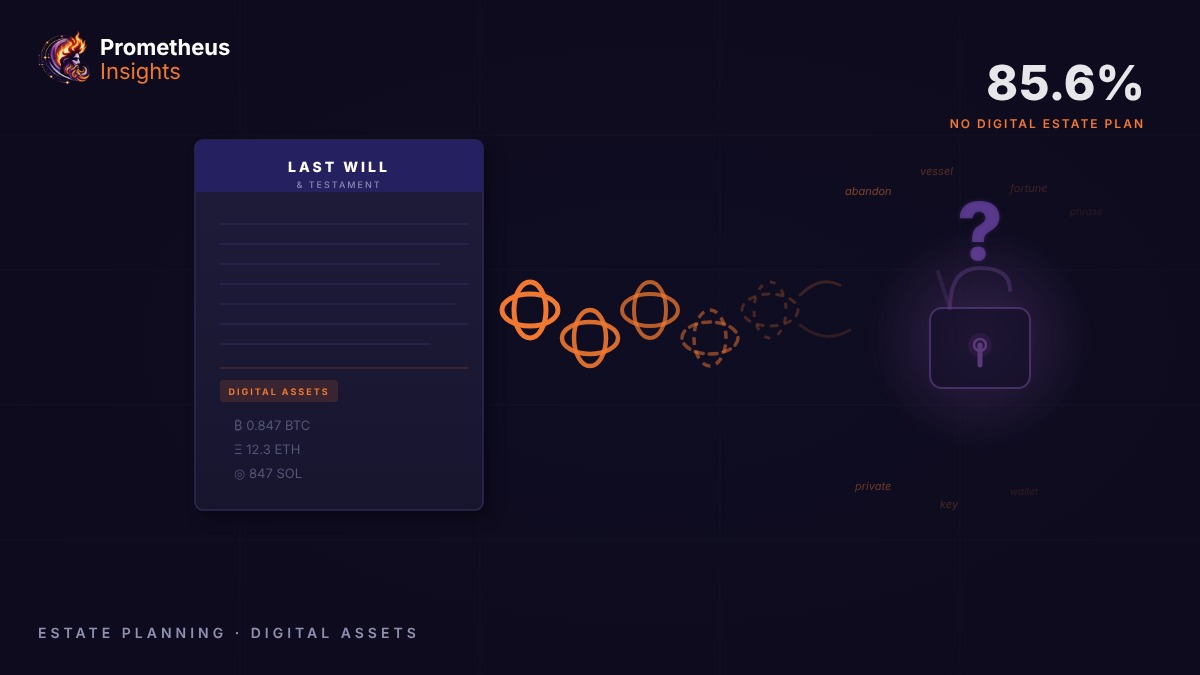
85.6% of UK adults have no digital access instructions in their will. With £5.5 trillion in intergenerational wealth transfers projected to 2050, the crypto inheritance gap is becoming a crisis.
We help crypto holders plan ahead so their assets stay secure and can be passed on. And when someone has died, we help executors and families find, access and value what was left, including hardware wallets where only part of the recovery phrase is known.
Most crypto lost on death is not stolen. It is lost to silence: nobody knew it existed, or nobody knew how to reach it. Good planning closes that gap without weakening your security today.
A confidential record of every exchange account, wallet, device and DeFi position you hold, so nothing is forgotten or invisible to your family. Reviewed as your holdings change.
We look at how your wallets and backups are set up today: hardware wallets, recovery phrase storage, passphrases and 2FA, and remove single points of failure.
An arrangement that lets your executors reach your crypto when the time comes, without anyone being able to take it early. Options include sealed instructions, split backups and multi-signature wallets.
A plain-English guide written for a non-technical executor: what you hold, where the instructions are kept, who to call and, just as important, what not to do.
Technical input so your will and letter of wishes deal with digital assets properly. Your solicitor drafts the documents; we make sure the crypto side actually works.
Current valuations and a record of what you paid and when, so your executors and advisers can deal with inheritance tax and capital gains without guesswork.
Planning does not mean handing us your recovery phrase. We design the arrangement and document it; you and your solicitor keep control of the keys and the instructions.
When someone dies holding cryptocurrency, the usual estate process often stalls. There may be no statement in the post, no customer service team to contact, and no way to reset access to a wallet that only the deceased knew how to open.
Families frequently know something was there: a hardware wallet in a drawer, payments to an exchange on a bank statement, a few words written on a scrap of paper. We turn those fragments into a clear picture of what existed, where it is now, and whether it can be recovered for the estate.
We review bank statements, emails, devices, paperwork and on-chain records to identify exchange accounts and wallets the deceased used, including ones the family did not know about.
Ledger, Trezor and other devices where the PIN is unknown or the recovery phrase is incomplete. We assess the device and every fragment you have, then attempt recovery where it is realistic.
Exchanges have their own bereavement procedures. We identify which platforms were used and give the estate’s solicitor the account evidence needed to make a claim.
Blockchain analysis confirms which addresses belonged to the deceased, what they held at the date of death, and whether anything has moved since.
Date-of-death valuations of every identified asset, with supporting evidence, to help executors complete probate forms and inheritance tax reporting.
Recovered assets are moved under a documented chain of custody to wallets or accounts controlled by the executors, ready for distribution or sale.
Most hardware wallets are backed up by a 12 or 24-word recovery phrase drawn from a fixed list of 2,048 words. Each missing word multiplies the number of possibilities by 2,048, so how much of the phrase survives decides whether recovery is realistic.
| What is known | Combinations to test | Typical outlook |
|---|---|---|
| Full phrase, device lost or broken | 1 | Very good The phrase restores the wallet on a new device. |
| All 12 words, order unknown | ~479 million | Good Built-in checksums rule out most orders quickly. |
| 1 word missing | 2,048 | Very good Tested in minutes. |
| 2 words missing | ~4.2 million | Good Usually achievable with standard hardware. |
| 3 words missing | ~8.6 billion | Possible Realistic with a known wallet address and significant computing time. |
| 4 words missing | ~17.6 trillion | Difficult Only with strong clues about the missing words or their positions. |
| 5 or more words missing | 36 quadrillion + | Unlikely Beyond practical brute force without other information. |
Figures assume a standard BIP39 phrase with the positions of the missing words known. If positions are unknown, an extra passphrase was set, or the wallet uses a non-standard derivation, the search grows. A known receiving address, partial letters, or the device itself can shrink it dramatically. Every case is assessed individually before any work begins.
We will tell you plainly at the outset how realistic recovery is. If the numbers are against you, we say so rather than take on work that cannot succeed.
We listen to what the family knows, review any documents or devices, and explain what is likely to be achievable.
We trace the digital footprint, identify wallets and exchange accounts, and assess any hardware wallet or partial phrase.
Where realistic, we attempt access, verify balances on-chain and produce date-of-death valuations.
Assets are transferred to the executors under chain of custody, with a written report for the solicitor, probate and HMRC.
No. We design and document the arrangement, but you and your solicitor keep the keys and instructions. We never need your phrase to build a plan.
We strongly advise against it. In England and Wales a will becomes a public document once probate is granted, so anyone could read it. Your will should refer to separate, securely held instructions instead.
There are several approaches, such as sealed instructions held by a solicitor, backups split between trusted people, or multi-signature wallets that need more than one key. The right one depends on how much you hold and who you trust; we help you choose and set it up.
Often, depending on how much is missing. With one or two missing words recovery is usually achievable. With three it can be possible, particularly if we know a wallet address. Beyond that the odds fall sharply unless there are strong clues. We assess every case before starting.
No. Many devices erase themselves after a small number of incorrect PIN attempts. Stop and keep the device safe. If a recovery phrase exists, the wallet can often be restored without the PIN at all.
Yes. Bank statements showing payments to exchanges, emails from crypto platforms, apps on a phone or laptop, and paperwork can all point to holdings. We review these and confirm what existed.
Most regulated exchanges have bereavement procedures and will release funds to the personal representatives once they receive documents such as the death certificate and grant of probate. We identify the accounts and provide the evidence your solicitor needs.
Cryptoassets form part of the estate and are generally relevant for inheritance tax. We provide date-of-death valuations and supporting evidence; your solicitor or tax adviser will advise on the reporting itself.
We never ask for a phrase by email or message. Sensitive material is handled under an agreed secure protocol, worked on offline where appropriate, and every step is documented.
This page is general information and is not legal, tax or financial advice. Every matter depends on its own facts, and recovery outcomes cannot be guaranteed.
Whether you are planning ahead or dealing with a loss, tell us what you know. We will tell you honestly what is realistic before any work begins.
85.6% of UK adults have no digital access instructions in their will. With £5.5 trillion in intergenerational wealth transfers projected to 2050, the crypto inheritance gap is becoming a crisis.
The first hour after a theft decides what can be recovered. The steps to take, in order, before the funds move out of reach.
